

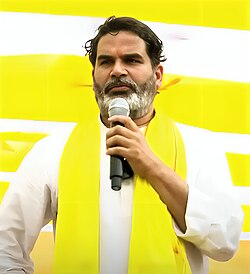
The Rise of Jan Suraaj: How Prashant Kishor is Redefining Bihar’s Political Landscape
Introduction: A New Chapter for Bihar
For decades, Bihar’s political canvas has been defined by familiar fault lines: entrenched caste dynamics, generational political families, and alternating coalitions that promised transformation but frequently delivered stagnation. Into this deeply rooted system stepped Prashant Kishor, a high-profile former political strategist turned grassroots campaigner. Moving away from whispering strategies into the ears of India’s most powerful leaders, Kishor decided to build a political vehicle of his own.
The launch of the Jan Suraaj Party (JSP) was not merely another addition to Bihar’s crowded electoral arena; it was framed as an ideological uprising centered around good governance, education, employment, and grassroots empowerment. While its initial electoral steps faced steep challenges, the trajectory of Jan Suraaj has evolved into one of the most compelling narratives in contemporary Indian politics, testing the resilience of established alliances and forcing a rethink on how political accountability is demanded.
The Genesis: From Strategy Rooms to the Mud Roads of Bihar
Prashant Kishor’s transition from a master strategist who engineered victories for multiple Chief Ministers across India to a direct political actor began with deep introspection.Recognizing that temporary electoral victories do not fix systemic rot, Kishor embarked on an unprecedented thousands-kilometer-long padyatra (foot march) across Bihar starting October 2, 2022, from the historic Gandhi Ashram in Champaran.
Walking through villages, district headquarters, and remote hamlets, Kishor listened to the grievances of ordinary citizens. The core premise of Jan Suraaj was simple yet radical: instead of imposing candidates from the top down based on calculations of muscle and money power, the party aimed to source candidates organically through deep public engagement and consensus.
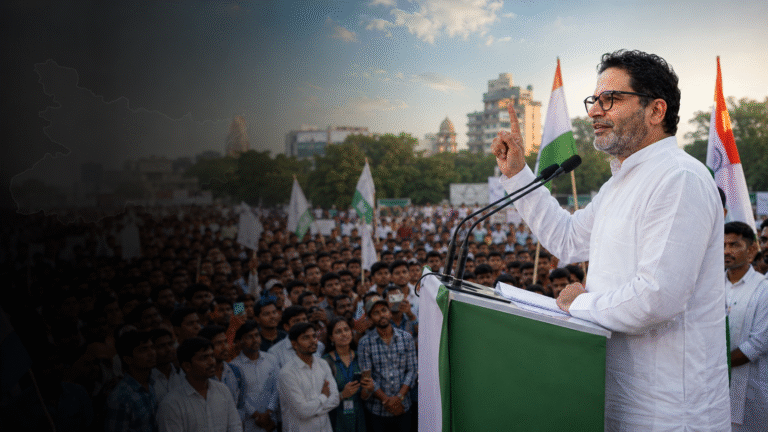
The movement culminated in the formal conversion of the Jan Suraaj Abhiyan into a political party on October 2, 2024, drawing massive crowds to Patna and signaling an intent to challenge the status quo comprehensively.
The Crucible: The 2025 Assembly Elections and Early Setbacks
Every revolutionary political movement faces a reality check at the ballot box, and for Jan Suraaj, that moment came during the 2025 Bihar Legislative Assembly elections.Despite massive media attention, high-energy campaigns, and exhaustive groundwork, the party faced a harsh debut, failing to secure a single seat in the initial assembly outing. Critics were quick to write off the experiment, arguing that grassroots goodwill does not automatically translate into electoral conversion in a state dominated by deeply entrenched social coalitions.
However, political analysts missed a fundamental truth: Jan Suraaj was structured as a long-term ideological shift rather than an overnight electoral flash in the pan. While mainstream parties like the BJP and JD(U) secured comfortable legislative majorities under Chief Minister Samrat Choudhary, the underlying socio-economic anxieties of Bihar’s youth remained unaddressed. Prashant Kishor chose not to retreat. Instead, he doubled down on grassroots organizing, institutionalizing party structures, and preparing for the inevitable political openings that would follow.
The Turning Point: The Bankipur By-Election Breakthrough
The turning point for Jan Suraaj arrived in mid-2026 during the high-stakes Bankipur Assembly by-election. Contesting directly in an urban-rural constituency that had long been considered a stronghold for established parties, Prashant Kishor threw his hat into the ring.
In a stunning result that shook the political establishment, Kishor secured a decisive victory, winning the seat by a comfortable margin and officially entering the Bihar Legislative Assembly as an MLA. This victory was symbolic and substantive. It proved that Jan Suraaj could transition from a movement of ideas into an electoral winning machine. Taking his oath as an MLA, Kishor instantly transformed from an outsider critic into an active legislator capable of setting the legislative agenda and holding the ruling NDA government accountable on the floor of the house.
Shaping the Narrative: Challenging the Establishment
Armed with legislative presence, Prashant Kishor has wasted no time in intensifying his scrutiny of the state government. Operating as a sharp opposition voice against Chief Minister Samrat Choudhary’s administration, Kishor has consistently focused public attention on governance gaps, institutional accountability, and developmental failures.
Whether questioning administrative neutrality during local electoral processes or highlighting lapses in crisis responses—such as advocating for grieving families after tragedies like local infrastructure or community accidents—PK has maintained relentless pressure on the ruling dispensation. By challenging the ruling coalition to address real-world governance issues rather than relying solely on identity politics, he has successfully repositioned the political debate in Bihar toward metrics of development, education, and employment.
Furthermore, Kishor’s nuanced commentary on veteran leaders like former Chief Minister Nitish Kumar reflects a strategic grasp of Bihar’s political psychology. By acknowledging past administrative efforts while sharply critiquing current governance paralysis and proxy leadership structures, Kishor separates individual respect from systemic critique—a sophisticated approach that resonates with a disillusioned electorate.
The Road Ahead: Expanding Horizons and Institutional Building
With the success in Bankipur and subsequent expansions into local body and Legislative Council elections, Jan Suraaj is systematically building a cadre-based organization. The strategy is no longer just about charismatic leadership; it is about building a durable political institution capable of contesting every tier of governance in Bihar.
The challenges ahead are formidable. Taking on established political machinery requires enduring financial resources, resilient local leadership, and continuous engagement with voters who are constantly courted with populist promises. Yet, Jan Suraaj has already achieved what few new political startups manage to do: it has survived its baptism by fire, secured a vital legislative foothold, and permanently altered the strategic calculations of both the ruling NDA and the opposition Mahagathbandhan.
Conclusion: Can Jan Suraaj Transform Bihar?
Prashant Kishor’s journey with Jan Suraaj represents a fascinating political experiment in modern India. It asks a fundamental question: Can a political party built on the promise of systemic structural reform displace parties built on identity and patronage?
While the ultimate answer lies in future ballot boxes, one thing is certain. Jan Suraaj has injected a new brand of accountability into Bihar’s politics. By refusing to fade away after early defeats and turning a single assembly win into a platform for broader state-wide discourse, Prashant Kishor has proven that the hunger for alternative politics in Bihar is real. Whether this movement matures into a ruling force or remains a permanent, sharp thorn in the side of the establishment, it has already rewritten the playbook of political mobilization in India’s most politically conscious state.Prashant Kishor Announces 5 Jan Suraaj Candidates
This video provides insights into Prashant Kishor’s strategic announcements and the ongoing expansion of the Jan Suraaj Party network across Bihar.